SCHOOL ASSEMBLIES
EXPLORE THE GLOBAL SOUNDSCAPE
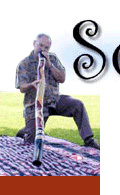
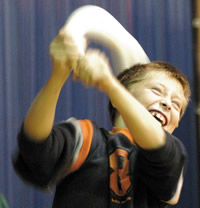
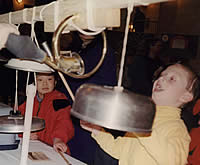
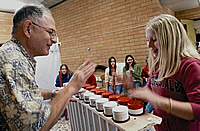
This is Dr. Hal's most popular program. Dr. Hal demonstrates and performs on instruments from aboriginal North and South America to aboriginal New Zealand and Australia. Members of your group may perform on pot lids, overhead whirling tubes, shakers and some of the instruments that Dr. Hal invents. How is pure sound used to communicate ideas and feelings? You find out here. There is nothing scripted about Dr. Hal. He works with you to be sure that your organization's values and objectives are reinforced in his messages about sound. How interactive do you want this..very to barely? Let Dr. Hal know and he will cater the program to your audience's needs. Dr. Hal performs on a conch shell, didjeridu, Balinese gangsa, neverlur, Native American flute, zampanos, harmonica and even a shower hose. With appropriately aged audiences he explains the science of sound and discusses the physiology of hearing. Dr. Hal's audiences have included pre- school through college physics classes.
|
Audiences are treated to a whirlwind tour of the globe during this learning and fun filled hour. Dr. Hal tells captivating creation and original stories about the instruments. He invites audience participation as he involves them in the creative and functional uses of sound in our culture. He leaves them inspired with a sense of the importance of listening carefully and using sound responsibly. Most importantly he will prove that you too can didjeridoo...and a lot more too. Geared for any age, kindergarten to adult. Assemblies are 45 to 75 minutes.
|
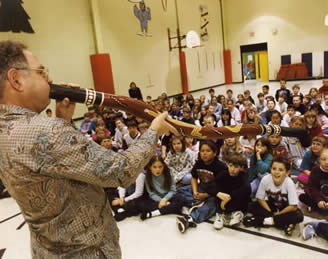
Geared for any age, kindergarten to adult
|
+Accomplishes instructional components suggested by content standard 8 and 9 of Music - Understanding relationships between music, the other arts, and disciplines outside the arts and music’s relation to history and culture. Dr. Hal’s programs also address national standards in science, social studies and language arts. ++Some of the scientific explainations are geared 4th grade and above.
|
Groove your Didjeridoos
GREAT FOR CUB SCOUTS & GIRL SCOUTS & BROWNIES
|
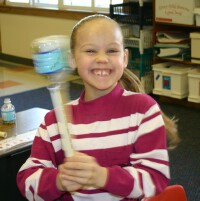 |
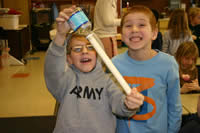
Spend 1 or 2 or more interactive hours making and exploring the sounds of musical instruments of the world. Dr. Hal will not only amaze you with some pretty zany instruments but he inspires you to create your own. Your audience develops a clear understanding of how and why musical instruments work. They make at least 3 instruments. They leave with a fine appreciation of the diversity of our global soundscape and with a didjeridoo too, of course. This program requires space for painting and decorating didjeridoos. *Very popular with scouts and camps.
|
WORKSHOPS ON Making & Creating
MUSICAL INSTRUMENTS
|
Sounds We Make ... and Take Have you ever heard of a flute loop, a water bottle bass? What's a finger gazimba anyway? Did you know that some slide whistles harbor a few hidden surprises? Can you find a turkey in that straw? Do you know what to do with a didgeridoo? Join Dr. Hal for a 1 1/2 hour romp in inventor heaven where you will be introduced to a world of real and invented instruments.
You'll have your choice of the above instruments and much more. Dr. Hal knows how to make them and he'll show you how to play them too. It makes no difference whether you have a degree from Julliard or if you are musically hopeless...this will get your creative juices flowing. If your not all thumbs you will make and take home at least 3 musical instruments ... who knows what they may be called.
|
| |
Make, Play, Decorate instruments that go Toot, Klunk, Plink, Crash and Bang. Explore the sound potential of stuff. What kinds of expressive musical instruments could you make if you only had a piece of paper? An elastic band? A straw? Some tape? Some string. Let's explore our environment for the musical materials that are out there and let curiousity and imagination go wild. Where is the creativity and invention in music education? It's right here.
|
| |
Grade 4* through adult. This is an instrument that anyone can play and it is one that you can easily improvise melodies on. Dr. Hal will help you make an exceptional instrument.
|
| |
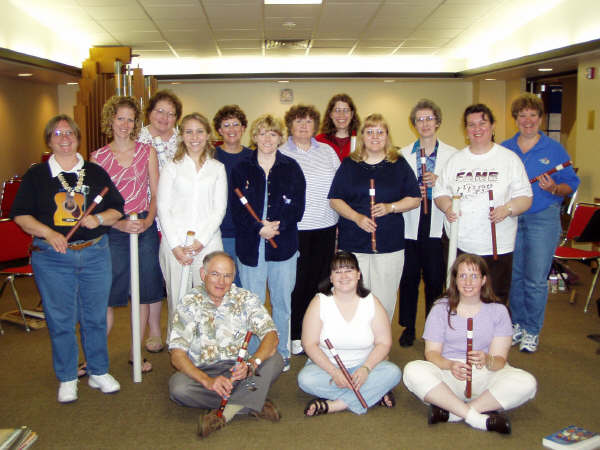
Silver Lake College - Native American Flute workshop
|
| |
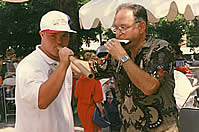
Grade 3* through adult. This is a great instrument that almost anyone can play. Dr. Hal does not promise that you will learn how to ciruclar breath in one easy lesson but he puts you on the right path. He is an expert in circular breathing and he just might say the right thing at the right time that will make you an expert too.
|
| |
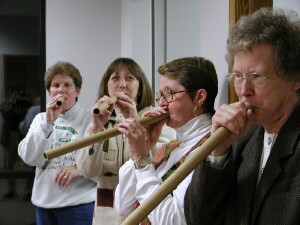 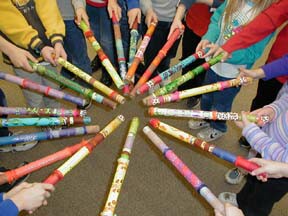
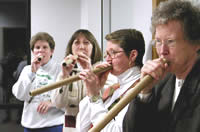
Adults learn to play a didjeridoo...an entire class decorates their didjeridoos.
|
| |
Gazimbas for Gesundheit. Making, Playing and Decorating a GAZIMBA
2 to 3 hours. Materials are shipped to program site in advance. Once you see and play this marimba-like instrument I guarantee that there will be no shortage of ideas on how it can be used in your classroom or practice. See it demonstrated, discuss its role and then roll up your sleeves and make one. Dr. Hal, inventor of the gazimba has had many field experiences using the GAZIMBA with all ages and musical abilities including those with physical and cognitive disabilities. The GAZIMBA is unusual, easy to play, easy to make and responds to the sensitivity of the slightest touch. It provides all kinds of creative outlets for all kinds of people. Listen to it and make one in this workshop. *A materials fee will be assessed.
|
| |
Making and Playing Zamponias (Pan Pipes).
2 hours. Materials are shipped to program site in advance in bulk kits. Dr. Hal comes to your site and we have a great time putting them together. These are easy to make and fun to play.
|
| |
Make and Play a Native American Shaker
1 hour..Dr. Hal comes to your site with the materials and you guys put em all together. We will even simulate a grand entry pow wow complete with drum and drummers. This is great fun and a wonderful experience.
|
Linking Sound Ideas in a Culturally Diverse World
|
| Any topics from above may be mixed to match your special workshop and inservice needs. |
| |
Making Sound Instruments that
Train, Teach, Motivate and Habilitate.
|
| |
Drawing on children’s capacity to imagine, invent and improvise, this session emphasizes developing lessons and creating musical instruments that train, teach and habilitate. Shakers, rattles, drums and flutes, gamelans out of pot lids, toilet paper rolls and pvc pipe. What are didjeridus, gamelans, gazimbas and finger-gazimbas anyway? Of what benefit are they in my classroom? You will find out here. Explore how to use them in your practice and learn how to make a few for yourself. Children love to explore sounds. Dr. Hal not only comes with a box full of them, he will show you how to get them "out of the box."
|
| |
What Dewey would do with a Didjeridoo
|
| |
Dewey would take it "out of the box" of course. Learn about how we hear and about the science of sound. Interact with the expressive sound technologies of cultures, have great fun learning to play world and zany musical instruments and participate in a model for integrating social studies, science, language and the arts.
|
| |
Inservice Workshop for Preschool/Nursery School providers
|
| |
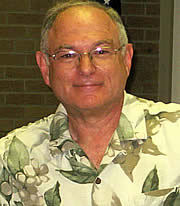
Children love sound. Spend 2 interactive and inspiring hours or a full day exploring sound and learning why it is critically important that children explore sounds in their environment. Dr. Hal Kacanek, president of Sounds We Make LLC, will not only amaze you with some pretty weird instruments but he will explain why you should make, play and have them available for children in your practice. He, his presentations, his instruments, his handouts and his children’s book Bric-a-brac are acclaimed for the way they tap the creativity of every child. (2 hours to a full-day) *A materials fee will be assessed for prepared instrument kits available from the presenter for those interested in building their own instruments.. |
| |
From Heavy Metal to PVC Pipe
|
| |
This program is an hour and a half of "sound" advice that shows how to make some pretty amazing musical materials that motivate children and adults. How might a series of pot lids, a shower hose, some random pvc pipe become critical parts of a great learning experience? To find the answers to that and more, come and explore the global soundscape with Dr. Hal Kacanek. Appropriate for those interested in learning the physics, biology, geography and sociology of sound.
|
| |
Gazimbas for Gesundheit.
|
| |
Make and play a newly invented musical instrument that makes you feel very special. Once you see and play this marimba-like instrument I guarantee that there will be no shortage of ideas of how it can be used in your classroom or practice. See it demonstrated, discuss its role and then roll up your sleeves and make one. Dr. Hal, inventor of the gazimba has had many field experiences using it with all ages and musical abilities including those with physical and cognitive disabilities. The gazimba is unusual, simple to play, easy to make and responds to the sensitivity of the slightest touch. It provides all kinds of creative outlets for all kinds of children. Listen to it and make one in this workshop. *A materials fee will be assessed.
|
| |
PVC Pipe Dreams; Make and Play Extraordinary
World and Creative Instruments
|
| |
Dr. Hal will guide you through the process of making, decorating and playing extraordinary world instruments from some very inexpensive plastic pipe. You will walk away with beautiful, authentic sounding instrument. Instrument options are Native American flutes, cow horn shaker, uli-uli, Aboriginal didjeridoo, Indonesian suling, Japanese shakuhachi, Irish penny-whistle, South American zampanos, creative flutes and slide whistles or perhaps you would like to build a gazimba. This is a great activity for camps, or for a one, two or three day workshops. *The number of instruments to be built is dependent on the setting (facility size and resources), the audience age and size, the number of facilitators and the amount of time available. |
|
Two Island Cultures; Java & Bali*
|
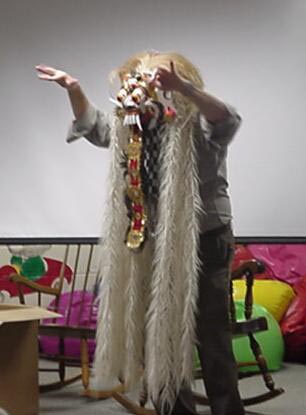
| Wow, how did this get in here? Dr. Hal has traveled to Indoneasia 9 times in the past 20 years. On 3 occasions he led students and adults on month long study tours to the islands of Java and Bali. He has imported many handicrafts including representative textiles, musical instruments, wood carvings, puppets, and fine silver granulation beads. In this introduction to the exotic and mysterious islands of Indonesia you will meet the Barong and Rangda; you'll hear the sounds of the gamelan and the wildly exciting sounds of the kecak dance. You will explore shadow puppetry, textile art, jewlery, carving and painting. Dr. Hal's presentation, will leave you wanting to travel there yourself. 50 minutes to 2 hours. Adult audiences. |
 |
Lectures
|
| |
Sounds; Symbols of our spirit
|
| |
Dr. Hal performans and discusses his composition (2007) "Three Murals for Earth Speaks".This lecture discussed how the imagery of Jose Clemente Orozco mural "The Epic of American Civilization" fueled ideas for a composition performed first for an interfaith conference entitled "Earth Speaks; on the environment" at Conference Point, Williams Bay, WI.
|
| |
|
Lecture Recital; Sounds We Make
Dr. Hal Kacanek performs on Suling, Gangsa, Harmonica, Shofar (Kudu horn), Conch Shell, Neverlur, Native American Flute, Shakuhachi, Zampanos, Tin-whistle, Showerhoseum, Funnelphoneumshowerhoseaphoneum, Digeridoo, Gazimba and Goodwill Gamelan as metaphors that explain both the communal and transcendent qualities of sound.
Artist in Residence
Schools have a variety of needs and expectations that an artist in residence is able to fulfill. Involvement in the creative process is a major part of that expectation. The key is developing an original work that involves as many members of the student body as possible. Such a process often culminates in an original project or performance. Dr. Hal’s residencies may include both.
Dr. Hal's residencies provide opportunities for
• making and creating instruments and exploring sound.
• making and playing world instruments
• improvising music
• improvising movement
• developing or supporting a dramatic presentation usually based on a fable or folklore
Some residencies feature Dr. Hal meeting individually with every class. Others have Dr. Hal working with grade levels and concentrating work with a small core group. Dr. Hal will collaborate with children, teachers and parent groups to meet their needs and to develop a creative, educational, memorable event that will be valued for years to come. Residencies may involve all parts of the curriculum; creating, integrating and exploring relevant aspects of music, art, theater, dance, language arts, social studies, history, math and science.
|
|